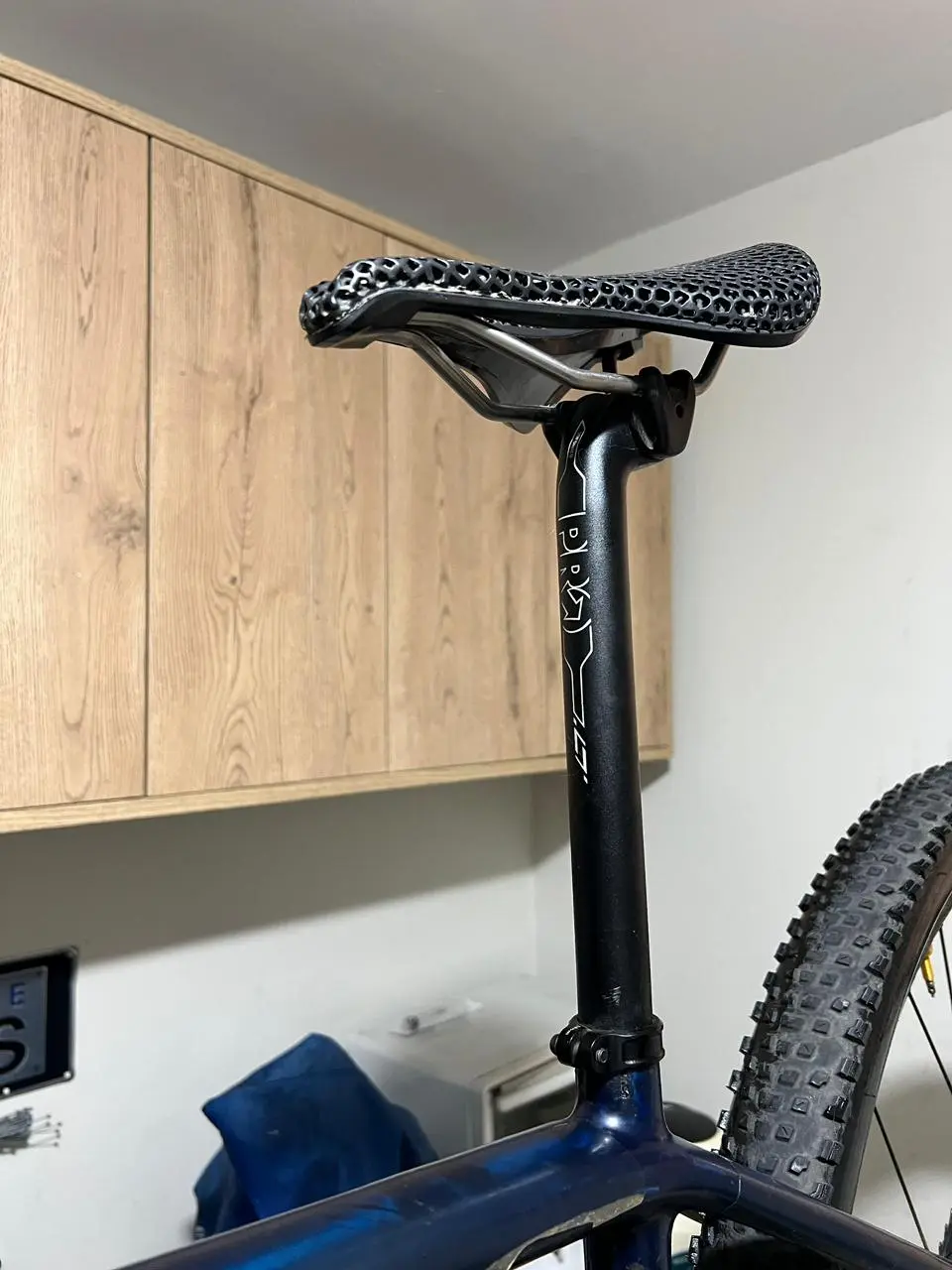
How do you remove a seatpost seized by galvanic corrosion? Take off the clamp, apply an ammonia-based penetrant to dissolve the aluminum hydroxide that welds it, and let it sit 24–48 h. If it won't budge, cool the inside of the post with CO₂ or dry ice to contract the metal —never apply heat, which destroys the carbon resin— and pull with linear traction. On aero profiles, never twist it.
The "stuck" seatpost is one of the most expensive and most avoidable failures on a modern bike. It isn't dirt or ordinary rust: in most cases it's galvanic corrosion, an electrochemical process that occurs when two materials of different potential share an electrolyte. The result isn't cosmetic: the metal forms a solid that expands inside the tube and mechanically locks the joint. Handled badly, it takes a multi-thousand-dollar frame with it.
The physics of the disaster: why carbon and aluminum "weld"
Carbon fiber is not an insulator: it is an excellent electrical conductor. In the galvanic series it behaves as a passive noble metal —a cathode, electrochemically close to gold or platinum—. Aluminum, by contrast, is one of the least noble materials: it acts as an anode and gives up electrons. When carbon and aluminum touch in the presence of an electrolyte (rainwater, sweat, road salt or coastal humidity), a cell closes: the aluminum corrodes at an accelerated rate.
The corrosion product is not harmless powder. The aluminum forms aluminum hydroxide, Al(OH)₃, a whitish solid of greater volume than the metal it came from. That growth is the key: the residue expands into the few-hundredths-of-a-millimeter clearance between post and tube and turns a friction joint into a mechanical lock. The post stops being a removable part and becomes, literally, part of the frame.
Aluminum post in a carbon frame → galvanic: the aluminum (anode) corrodes. Carbon post in an aluminum frame → also galvanic: the aluminum seat tube is what corrodes. Carbon post in a carbon frame → NOT galvanic: there is no electrochemical couple. If that one seizes, it's from rough resin, packed dirt or dried grease, and it's solved with cleaning, not aggressive chemistry.
Hard data: the scale of the problem
The galvanic potential difference of the carbon-fiber / aluminum couple in a salt environment reaches 0.8–1.0 V. For scale: the industrial threshold considered safe to avoid active galvanic corrosion is just 0.15–0.25 V. We are four to six times above the limit: carbon acts as a large-area electron sink and drives the aluminum to corrode fast.
Linear expansion coefficient: aluminum ≈ 23 × 10⁻⁶ K⁻¹; carbon fiber along its axis ≈ −0.5 to +1 × 10⁻⁶ K⁻¹ (it barely expands, and may even contract). Heating the tube expands the assembly very little and, before achieving that, it exceeds the glass-transition temperature (Tg) of the epoxy resin, ~60–120 °C, softening the composite. That's why direct heat destroys the frame before freeing anything.
How NOT to remove it (the mistakes that break frames)
1. Torch or heat gun. Softens the resin (Tg 60–120 °C) long before expanding the aluminum. Delaminates the carbon.
2. Common WD-40. It's a water displacer, not a salt solvent. It won't break down Al(OH)₃.
3. Mallet and blows. Carbon resists compression and axial tension, but shear impact delaminates the fiber layers instantly.
4. Twisting an aero post. On non-round profiles (D-shape, kamm-tail) or integrated posts, any rotation cracks the frame's seat tube. The force can only be linear.
The correct protocol, least to most aggressive
1. Relieve the real pressure
Fully remove the clamp bolt or wedge; loosening isn't enough. Many people "pull" against a still-closed clamp and conclude the post is welded when it was simply still held.
2. Attack the chemistry, not with force
The blockage is aluminum hydroxide, an alkaline salt. The agent that dissolves it without attacking the resin or the sound aluminum is ammonia. Apply it at the interface —with the frame inverted so it runs down by gravity over the affected zone— and give it a capillary soak of 24 to 48 hours. Patience does more than leverage.
3. Inverse thermal shock
If it persists, don't heat: cool from the inside. Introduce dry ice or a short burst of CO₂ into the post to contract the metal and crack the crystalline residue. It's the opposite of instinct, and it's what respects the material.
4. Linear traction at the bench
Only then, and only on round posts, clamp the post (not the frame) in a bench vise with soft jaws and apply linear traction by rotating the frame around the axis. On aero posts, replace the twist with a pure-pull extractor on the post head. If the frame is expensive or the post is a proprietary profile, this is the point to take it to a workshop before improvising.
Table: extraction agents and methods
| Method | Mechanism | Structural risk | Galvanic efficacy |
|---|---|---|---|
| Ammonia-based penetrant | Chemically dissolves Al(OH)₃ | None (safe for resin and metal) | Maximum |
| Dry ice / CO₂ (internal cold) | Contracts the aluminum, cracks the residue | Low (protect skin) | High |
| Heat (>150 °C) | Tries to expand the tube | Critical: delaminates carbon | Unacceptable |
| Phosphoric acid (cola/soda) | Mild acid attack | Medium (attacks anodizing) | Low and slow |
Prevention: the problem that should never have existed
A seized post is almost always the result of incorrect installation or maintenance. Prevention is cheap and rests on three pillars.
A barrier between materials. Separate carbon and aluminum with assembly paste (which also adds grip via silica micro-particles) or, on metal-to-metal joints, with an anti-seize. Compound selection matters: the goal is to cut the electrical contact and displace the electrolyte.
Correct clamp torque. With assembly paste, the clamp works in a safe range of 4–5.5 N·m instead of the 8–10 N·m a dry metal-to-metal joint would demand. Always use a torque wrench and respect the value printed on the frame: over-tightening crushes the carbon tube.
Periodic removal. Pull, clean and reapply every 6 months or ~3,000 km, and every 3 months if you ride in rain, mud or near the sea. Moving the post twice a year is what separates a five-minute service from a destructive extraction.
The same electrochemical principle that attacks the post attacks the whole bike in a coastal climate; we develop it in our episode on corrosion and thermodynamics.
BikeLab Studio.
Frequently Asked Questions
Does regular grease damage a carbon seatpost?
No. The cured epoxy resin is inert to mineral grease; the myth comes from confusing fiber with paint or from posts that slip. The real difference is functional: grease lubricates and may let the post slip, while assembly paste adds silica that increases friction and lets you clamp with less torque. In a carbon-aluminum pair, what matters is that both barriers separate the materials and slow galvanic corrosion.
Does a carbon post inside a carbon frame corrode galvanically?
No. Galvanic corrosion needs two materials of different potential plus an electrolyte. Carbon against carbon forms no galvanic couple: if it seizes it is from rough resin, packed dirt or dried grease. There the fix is mechanical or cleaning-based (hot water, ultrasonic), not aggressive chemistry.
Why shouldn't I heat the frame with a torch to free the post?
Because the carbon's epoxy resin loses stiffness at its glass-transition temperature, typically 60–120 °C, long before the aluminum expands enough. Heating ruins the composite matrix. The correct thermal shock is inverse: cool the inside of the post (dry ice or CO₂) to contract the metal.
How often should I remove the post so it doesn't seize?
Every 6 months or about 3,000 km as a general rule, and every 3 months if you ride in rain, mud or a salty coastal environment. Each time, clean the interface, inspect it and reapply assembly paste. A seized post is almost always the result of never moving it.
What torque should I use on the seatpost clamp?
Always follow the value printed on the frame or post. With assembly paste, the usual safe range is 4–5.5 N·m, versus 8–10 N·m for a paste-free metal-to-metal joint. Over-tightening crushes the carbon tube; a torque wrench is not optional.
References
- Park Tool — Seized Seatposts and Stems.
- Corrosion Science (Elsevier) — Galvanic corrosion of Al-alloy / CFRP couples and the role of corrosion-product deposition.
- Galvanic series of materials in salt environments (aerospace references) — potentials of carbon, aluminum and steel.
- L. Zinn / C. Calfee — technical notes on grease versus assembly paste on carbon composites.
- Seatpost and frame manufacturer specs (ENVE, Ritchey, Wolf Tooth) — seatpost clamp torque.