HG (Hyperglide)
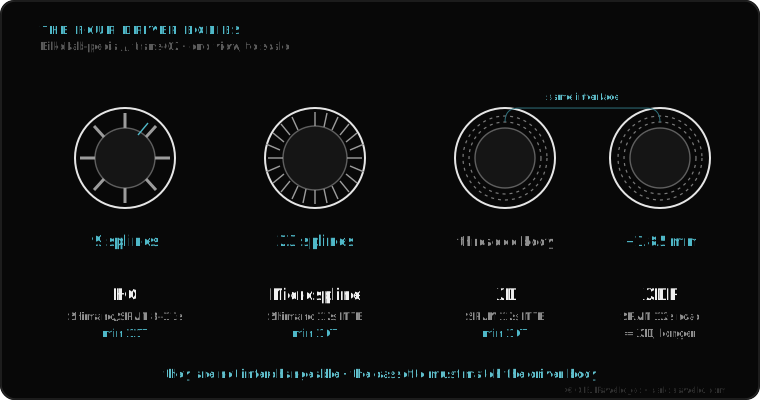
HG (Hyperglide) is the world's most widespread freehub standard, created by Shimano. It has 9 splines (one narrower, so the cassette fits one way only) and takes 8- to 11-speed cassettes from Shimano, SRAM and others. Its limit is geometric: the smallest cog can't go below 11 teeth, because the freehub body is wider than a 10T cog. That's why modern 12-speed systems with a 10T cog use other freehubs (Microspline, XD).
If your bike is entry- or mid-level, it almost certainly runs HG. It's cheap, robust and universal for 8-11 speeds.
What it is and why it dominates
The cassette slides over the 9 splines and is held by a lockring; the narrow spline forces a single mounting position. It's the longest-lived, most compatible standard: nearly every entry- to mid-level bike uses it. Its only real limit is that it can't house a 10-tooth cog.
Key data
What it fits
It takes Shimano, SRAM and third-party (SunRace, Box) cassettes from 8 to 11 speeds, and some budget 12-speed cassettes that start at 11T (like SRAM NX Eagle). It won't take 10T cassettes: neither high-end SRAM Eagle (XD) nor Shimano 12-speed (Microspline).
If you're unsure which cassette, freehub or chain fits your bike, send us the case. Real diagnosis, nothing to sell you. Message us on WhatsApp
Frequently asked questions
Does HG accept 12 speeds?
Some 12-speed cassettes with an 11T cog (like SRAM NX Eagle) do mount on HG. Mid- to high-end ones with a 10T cog don't: they need Microspline or XD.
Are the road and MTB HG freehubs the same?
Almost: the 11-speed road one is ~1.85 mm wider. That's why an 8-10sp MTB cassette needs a spacer to fit an 11sp road freehub.
Are HG and HG+ the same?
No. HG is the physical freehub; HG+ (Hyperglide+) describes the shift ramps on Shimano 12-speed cassettes.