Center Lock vs 6-bolt
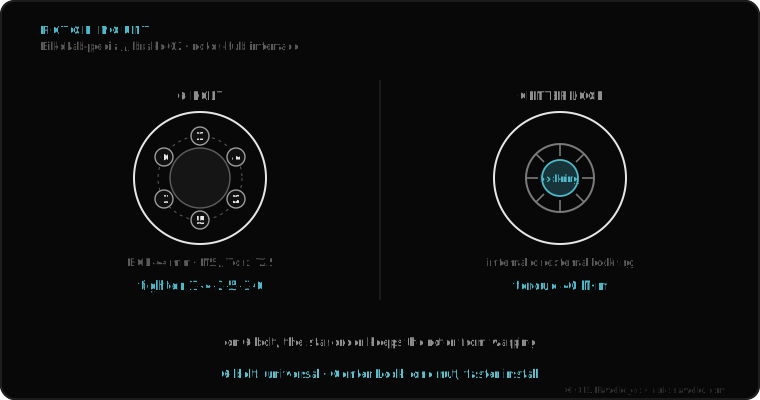
They're the two ways to fix the rotor to the hub. 6-bolt: six M5 Torx bolts on a 44 mm circle, tightened in a star — universal and serviceable in any shop. Center Lock: the rotor engages the hub splines and is fixed with a central lockring at 40 N·m — faster to fit and self-centering, but a specific hub interface. Your hub decides it: 6 holes or splines. You can cross from Center Lock to 6-bolt with an adapter, not the reverse.
Your hub decides this, not your brake: six little bolts or one central nut? That determines which rotor you buy.
How to tell them apart and which to choose
Look at your hub: if the rotor is held by six bolts, it's 6-bolt (universal, cheap, reliable); if it sits on splines with a central nut, it's Center Lock (fast, centered, a bit pricier with its tool). In performance they're equivalent; the choice is set by the hub you already have. Center Lock needs the lockring tool (cassette or BB type depending on the lockring).
Head to head
What you can and can't
A 6-hole hub uses a 6-bolt rotor; a Center Lock hub uses a Center Lock rotor (open Shimano/SRAM standard). You can mount a 6-bolt rotor on a Center Lock hub with an adapter; a Center Lock rotor can't be adapted to a 6-hole hub. The mounting type doesn't change the size or the caliper mount.
If you don't know which mount, rotor or fluid your brake uses, send us the case. Real diagnosis, nothing to sell you. Message us on WhatsApp
Frequently asked questions
Which is better, Center Lock or 6-bolt?
In braking they're equivalent. Center Lock is faster to fit and self-centers; 6-bolt is universal and cheap. Choose by the hub you already have.
Can I put a 6-bolt rotor on a Center Lock hub?
Yes, with a Center Lock-to-6-bolt adapter. Not the reverse: a Center Lock rotor won't fit a 6-hole hub.
What tool does Center Lock need?
The lockring tool: the cassette one (FR-5) for the internal lockring, or the BB one for the external (required on 15/20 mm axles).