Hub spacing (OLD)
Hub spacing —OLD (Over-Locknut Dimension)— is the distance between the outer faces of the hub locknuts, and it must match the inner space between the frame or fork dropouts. It's the measurement that decides whether a wheel physically fits your bike. Common values: front 100 or 110 mm; rear 135, 142, 148 (Boost) or 157 (Super Boost). If the hub OLD doesn't match your frame, the wheel won't fit (or fits forced and damages the frame).
It's the first compatibility filter of any wheel: if the width doesn't match, nothing else matters.
What it is and how to measure it
OLD is measured with a caliper between the flat faces of the hub locknuts (or between the inner faces of the dropouts, with the wheel removed). It's an external figure: don't confuse it with the axle length, which is longer. Half a millimeter tolerance is acceptable on steel or aluminum; on carbon, none: the width must be exact.
Standard values
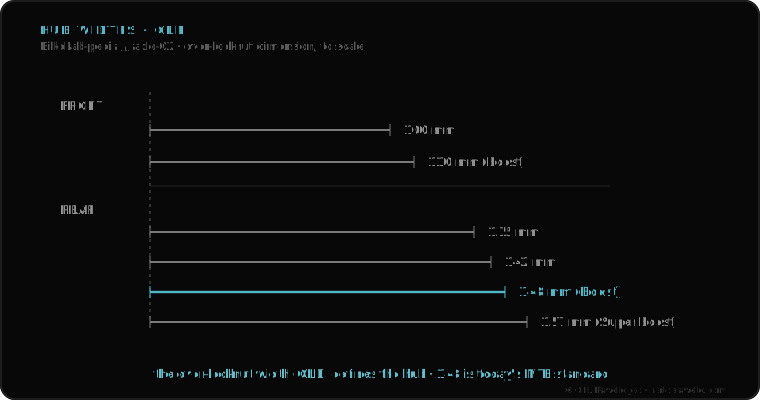
What it fits
The hub OLD must be identical to the width your frame or fork specifies. There's no conversion without adapters (endcaps), and even then it isn't always possible. Before buying a wheel, confirm your width by measuring between dropouts.
If you don't know which axle, width or thread your frame uses, send us the case. Real diagnosis, nothing to sell you. Message us on WhatsApp
Frequently asked questions
How do I measure my bike's OLD?
Remove the wheel and measure with a caliper the distance between the inner faces of the dropouts where the hub rests. That's your width.
Is OLD the same as axle length?
No. OLD is the width between hub locknuts; the axle is longer because it passes through the dropouts. Different things.
Can I force a frame to another width?
On steel, sometimes, with controlled cold-setting. On aluminum or carbon, never: it destroys it.