Boost 148 (rear)
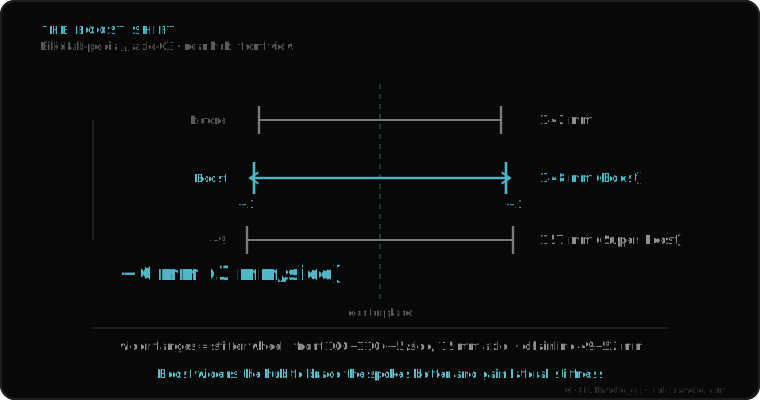
Boost 148 is the most widespread mountain bike rear hub standard. It's 148 mm wide, 6 mm more than 142 (3 mm per side), and uses a 12 mm thru-axle. That extra width spreads the hub flanges, opening the spoke angle for a stiffer wheel with room for wide tires. It also shifts the chainline from 49 to 52 mm. It's not a 142 «with a spacer»: the whole hub positions the cassette 3 mm further out, and it requires a Boost frame and chainring.
If your MTB is from 2016 onward, it's almost certainly Boost. It's the width that made big 29-inch wheels stiff.
What it is and what changes
Boost doesn't change the cassette or chain: it changes where the whole hub sits in the frame. By spreading the flanges 3 mm per side, the spokes form a wider triangle and the wheel flexes less. Since the cassette ends up 3 mm further out, the chainring must move too (52 mm chainline), usually with a 3 mm chainring offset. That's why a Boost frame needs a Boost crank/ring.
Key data
What it fits
It fits frames designed as Boost 148 and needs a chainring with Boost chainline (52 mm, 3 mm offset). It won't fit 142 or 135 frames. A 142 hub can be adapted to a Boost frame with a spacer kit and rotor repositioning, but a native 148 hub can't be «shrunk» to 142.
If you don't know which axle, width or thread your frame uses, send us the case. Real diagnosis, nothing to sell you. Message us on WhatsApp
Frequently asked questions
Is Boost 148 compatible with a 142 frame?
Not directly. They're different widths; the frame must be 148 mm. You can only adapt a 142 hub to a Boost frame with a conversion kit, not the reverse.
Is a Boost cassette different?
No. The cassette mounts the same; what changes is that the whole hub positions it 3 mm further out. That's why the chainline shifts to 52 mm.
Do I need special cranks for Boost?
You need a 52 mm chainline, usually via a 3 mm offset chainring. Many cranks solve it with the ring, not the spindle.